

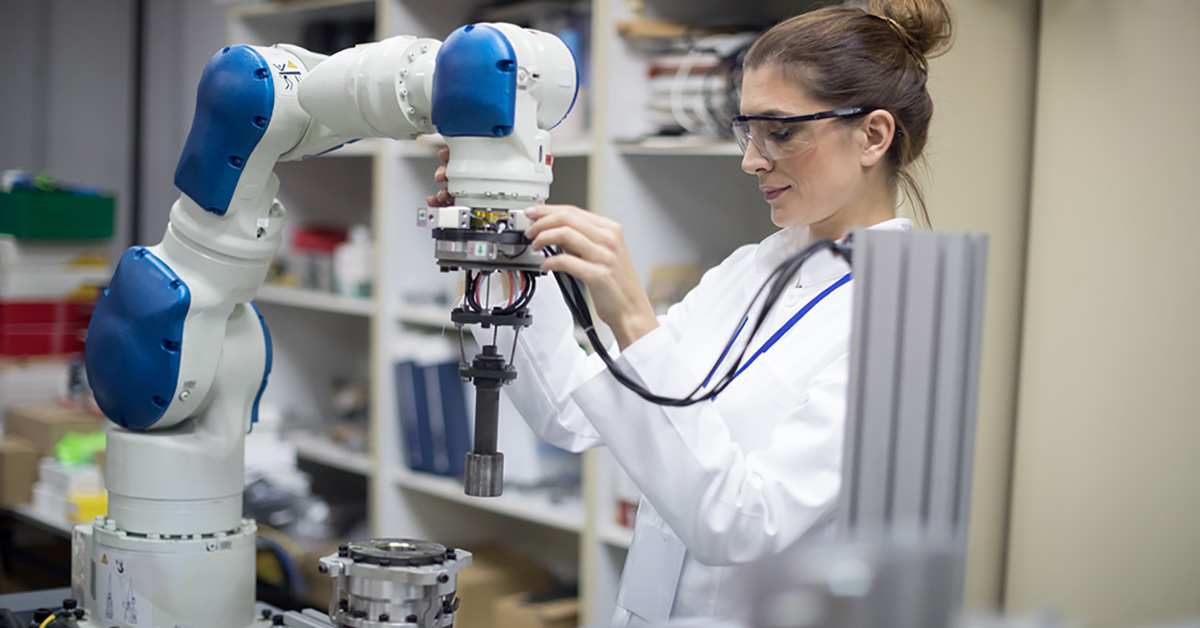
End-of-arm tooling, commonly referred to as EOAT, describes the device or combination of devices mounted at the wrist of a robot that directly interacts with parts, tools, or the surrounding environment. While robotic arms often dominate discussions about automation, it is EOAT that ultimately defines what a robot can do and how well it can do it. In collaborative robotics, where robots operate in close proximity to human workers, EOAT takes on an even more decisive role. The choice of tooling affects not only task feasibility but also accuracy, cycle time, safety, and adaptability to changing production needs. For production managers, automation engineers, and decision-makers, understanding EOAT is essential for evaluating the real capabilities of a collaborative robot system.
EOAT is sometimes treated as a secondary component, selected late in the automation design process once the robot itself has been chosen. This approach often leads to compromises that only become visible during operation, such as reduced throughput, inconsistent part handling, or overly conservative safety settings. In practice, EOAT should be considered a core element of the robotic system from the outset. The physical interface between robot and workpiece influences gripping stability, repeatability, and dynamic performance. In collaborative applications, where flexibility and rapid changeovers are often key objectives, tooling decisions can either unlock the full potential of automation or become a limiting factor that constrains productivity.
Main Categories of End-of-Arm Tooling
EOAT encompasses a broad range of tools designed for different handling and process requirements. Mechanical grippers are among the most common types and use jaws or fingers to grasp parts through friction or form-fit. They are well suited for components with defined geometries and offer high holding forces relative to their size. In collaborative robotics, electrically actuated mechanical grippers are widely used because they allow precise control over gripping force and position. This controllability is important when humans and robots share a workspace, as it supports predictable behavior and simplifies safety assessments.
Vacuum grippers form another major EOAT category and are frequently used in packaging, palletizing, and sheet handling applications. By creating negative pressure, they can handle a wide variety of flat or gently contoured objects without mechanical adjustments. Their versatility makes them attractive for high-mix production environments, but they also introduce dependencies on vacuum generation and air quality. Surface condition, porosity, and contamination can all affect gripping reliability, which must be considered during system design and validation.
Magnetic grippers are typically applied when handling ferromagnetic materials such as steel parts. Their main advantages include fast engagement, simple construction, and minimal mechanical wear. In collaborative environments, permanent or switchable magnetic grippers can reduce mechanical complexity, but they require careful attention to safety. Unintended attraction of nearby objects or residual magnetism can create risks if not properly managed. As with all EOAT solutions, suitability depends on the specific application rather than on the tool category alone.
Beyond gripping, EOAT also includes force and torque sensors that enable robots to detect interaction forces with high precision. These sensors are especially important in collaborative robotics, where compliant motion, delicate assembly, and safe physical interaction are often required. Tool changers represent another important EOAT class, allowing robots to automatically switch between different tools within a single cell. This capability significantly increases flexibility and enables one robot to perform multiple operations without manual intervention.
How EOAT Influences Performance and Accuracy
The performance of a collaborative robot cannot be evaluated independently of its EOAT. Tool mass and inertia directly affect achievable acceleration and deceleration, which in turn influence cycle time. Oversized or poorly balanced tooling may force the robot to operate at reduced speeds, limiting throughput even though the robot itself is capable of more. In applications with tight takt time requirements, such inefficiencies can undermine the business case for automation.
Accuracy and repeatability are equally dependent on EOAT design. Even if a robot arm offers high positional repeatability, the effective accuracy at the workpiece is determined by how consistently the tool holds and releases parts. Compliance in gripper fingers, variation in vacuum seals, or mechanical play in tool changers can all introduce positioning errors. From a process engineering perspective, EOAT must be considered part of the kinematic chain that translates programmed motion into real-world results. Ignoring this relationship often leads to unrealistic expectations during system planning.
EOAT for Industrial Robots Versus Collaborative Robots
Traditional industrial robots are typically isolated from human workers by safety fencing and optimized for high speed and payload. Their EOAT can therefore be heavier, more rigid, and highly specialized, as safety is ensured through physical separation rather than through the intrinsic properties of the system.
Collaborative robots operate under different assumptions. They rely on force limitation, speed monitoring, and controlled interaction to enable shared workspaces. As a result, EOAT for cobots must be designed with safety as an inherent characteristic. Sharp edges, uncontrolled motion, and excessive gripping forces are unsuitable in close proximity to people. This has led to the widespread use of lightweight materials, rounded geometries, and electrically driven actuators with fine force control. In collaborative automation, EOAT is an active contributor to system safety rather than a passive attachment.
Integration, Reconfigurability, and Deployment Speed
One of the central promises of collaborative robotics is faster deployment and easier reconfiguration, particularly for small and medium-sized enterprises. EOAT plays a crucial role in whether this promise can be realized. Tooling that requires complex wiring, external controllers, or extensive custom programming increases integration effort and reduces flexibility. EOAT designed for direct compatibility with robot controllers supports shorter commissioning times and lower engineering costs.
Manufacturers such as Onrobot focus specifically on developing collaborative robot end-of-arm tooling that emphasizes ease of integration, modularity, and reusability across different cobot brands. From an operational standpoint, this approach reduces reliance on specialized integration work and allows internal teams to adapt automation cells as production requirements change. For decision-makers, this improves scalability and provides greater control over how automation investments evolve over time.
EOAT and Total Cost of Ownership
The purchase price of EOAT represents only a small portion of its total cost of ownership. Maintenance requirements, energy consumption, downtime associated with tool changes, and the effort required for reprogramming all contribute to long-term costs. Tooling that appears inexpensive initially may generate higher expenses if it requires frequent adjustments or specialized expertise to maintain. For many small and medium-sized enterprises, these indirect costs have a decisive impact on the overall economics of automation.
Reliability is particularly important in collaborative environments, where robots are often expected to operate continuously alongside human workers. Unplanned stops caused by gripping failures or sensor issues disrupt production flow and undermine confidence in automation. EOAT designed for predictable performance and long service intervals supports stable operations and simplifies maintenance planning. Over time, this reliability contributes to lower operating costs and more consistent output.
Scalability further influences total cost of ownership. As product variants increase or volumes change, the ability to reuse or adapt existing tooling becomes increasingly valuable. Modular EOAT systems and automatic tool changers allow companies to expand or modify automation cells without redesigning them from scratch. This reduces future capital expenditure and shortens the payback period of initial investments.
EOAT as a Strategic Element of Collaborative Automation
Selecting EOAT is not a minor technical detail but a strategic decision that shapes how collaborative robotics supports production objectives. For production managers, tooling determines whether a cobot can meet cycle time targets and maintain consistent quality. For maintenance teams, it influences service routines and fault diagnosis. For automation engineers and system integrators, EOAT defines the practical limits of what processes can be automated safely and efficiently.
In collaborative environments, EOAT also affects how smoothly humans and robots can work together. Well-chosen tooling supports predictable behavior and intuitive interaction, while poorly matched tools introduce safety concerns and operational friction. A solid understanding of EOAT fundamentals enables decision-makers to evaluate automation solutions at the system level, rather than relying solely on robot specifications, and to make choices that align technical capability with long-term operational goals.
