

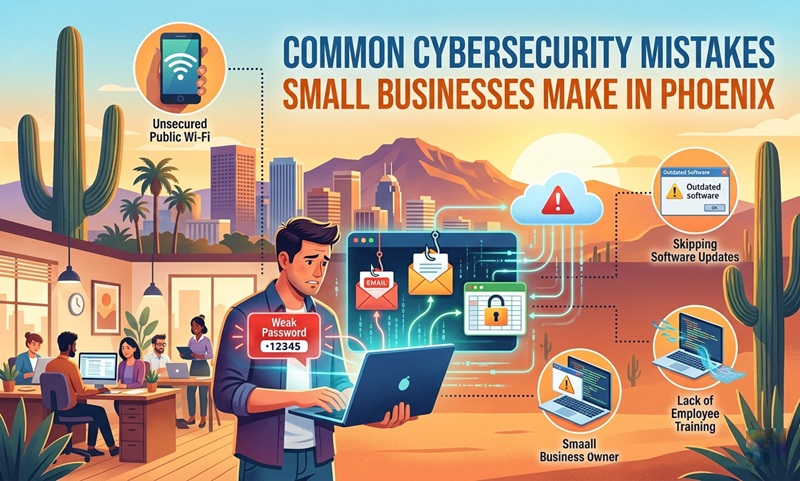
A breach doesn’t care how small your company is. In fact, small businesses are now the primary target for cybercriminals precisely because they tend to have fewer defenses. In Phoenix, where a rapidly growing tech corridor and remote work expansion have increased digital exposure, small businesses are dealing with cyber threats that even some mid-sized companies struggle to handle.
Here are the most common cybersecurity mistakes small businesses in Phoenix make — along with practical, actionable fixes.
Why Small Businesses in Phoenix Are Increasingly Targeted
Phoenix’s business growth has been dramatic. According to regional economic data, Arizona added thousands of new small businesses annually through the early 2020s. That growth is great for the local economy, but it also means more inexperienced operators managing systems that hold sensitive financial, customer, and employee data.
Cybercriminals run volume-based attacks. They use automated tools to probe thousands of systems looking for weak spots — and small businesses almost always have more of them.
Top Cybersecurity Mistakes Small Businesses Make in Phoenix
Mistake 1: Using Weak or Reused Passwords
This remains the single most common entry point. A Phoenix restaurant owner who uses the same password for their POS system, email, and QuickBooks account has essentially left three doors unlocked with the same key.
Fix: Implement a business password manager (1Password Teams or Bitwarden Business) and enforce unique, complex passwords for every system. Enable multi-factor authentication (MFA) everywhere possible.
Mistake 2: Not Training Employees on Phishing
Most breaches don’t start with sophisticated hacking — they start with someone clicking a link in a convincing email. Phishing attacks have become increasingly targeted and sophisticated, with some mimicking local Arizona government agencies or popular regional vendors.
Fix: Run quarterly phishing simulation tests using tools like KnowBe4 or Proofpoint. Make security awareness training part of new employee onboarding.
Mistake 3: Ignoring Software Updates
Small business owners are busy. It’s easy to click “remind me later” on a Windows update or delay a router firmware upgrade. But many of the most damaging malware attacks in the past five years — including ransomware variants active in the Southwest — have exploited known vulnerabilities in unpatched software.
Fix: Enable automatic updates for operating systems, applications, and network hardware. Assign a monthly “update check” to one person on your team.
Mistake 4: No Backup or Disaster Recovery Plan
If ransomware encrypts your files tomorrow, could you restore your business data? Most small Phoenix businesses can’t answer “yes” to that question. Without backups, a ransomware attack can be permanently devastating.
Fix: Follow the 3-2-1 backup rule — 3 copies of data, on 2 different media types, with 1 stored offsite or in the cloud. Test your restoration process at least twice a year.
Mistake 5: Using Consumer-Grade Hardware on Business Networks
Home-grade Wi-Fi routers and ISP-provided modems are not built for business security. They lack features like network segmentation, VLAN support, and enterprise logging — all of which matter when a breach happens.
Fix: Upgrade to a business-grade router (Ubiquiti, Cisco Meraki, or similar). Segment your guest Wi-Fi from your business operations network.
Cybersecurity Risk Level by Business Type (Phoenix Context)
| Business Type | Common Vulnerabilities | Priority Fix |
|---|---|---|
| Retail / POS systems | Card skimming, POS malware | PCI-DSS compliance, MFA |
| Medical/dental offices | HIPAA data exposure | Encrypted storage, access control |
| Real estate offices | Wire fraud, email compromise | Email security, staff training |
| Restaurants | POS systems, delivery apps | Network segmentation |
| Professional services | Client data theft | Password manager, MFA |
Pro Tips from IT Security Professionals
- Get a free cybersecurity assessment. The Arizona Small Business Development Center (AZSBDC) offers resources and connections to vetted local IT consultants.
- Don’t share admin credentials. Every employee who needs system access should have their own login. Shared admin accounts make breach investigation nearly impossible.
- Check your cyber insurance. Arizona businesses increasingly carry cyber liability policies, but many small businesses don’t know what theirs actually covers. Read the exclusions.
Common Mistakes to Avoid
- Thinking “we’re too small to be targeted.” Size is not protection. Automated attacks don’t discriminate.
- Relying on antivirus alone. Antivirus software catches known threats. Modern attacks increasingly bypass it.
- Delaying after a suspected breach. If you think you’ve been compromised, call an IT professional the same day. Delays allow attackers to establish deeper access.
FAQs
Q: How much does a cybersecurity breach cost a small business?
IBM’s annual Cost of a Data Breach report consistently puts the average cost in the hundreds of thousands for small businesses when factoring in recovery, legal exposure, and lost business.
Q: Does my small Phoenix business need a dedicated IT security person?
Not necessarily. A managed security service provider (MSSP) can handle most needs cost-effectively for businesses under 50 employees.
Q: Are there local cybersecurity resources for Phoenix small businesses?
Yes — the Arizona Small Business Development Center and Greater Phoenix Chamber of Commerce both provide cybersecurity guidance and referrals to local IT vendors.
Q: What is the biggest cyber threat to small businesses right now?
Business Email Compromise (BEC) and ransomware remain the top two threats by financial impact for small businesses nationwide.
Conclusion
Cybersecurity doesn’t require a corporate IT budget — it requires consistent habits. Start by fixing the basics: strong passwords, MFA, phishing training, and automated backups. These four changes address the majority of small business breach scenarios. In a fast-growing market like Phoenix, taking security seriously isn’t just about protection — it’s part of running a professional, trustworthy operation.
